Monday, August 07, 2006

Size matters when you whip it out onto the table...

Size matters. Men don't often jump up and claim proudly that theirs is the smallest. But when it comes to office gadgetry, small is beautiful. Who wants to be the owner of the biggest mobile phone in the office?

As a business psychologist, I go to lots of meetings. And I have size issues when it comes to notebooks too. When you go into a meeting and everyone else is thrusting huge personal organisers and thick notebooks on the table, I produce my little Moleskine notebook. Measuring just slightly smaller than the span of my hand, the elegant but sturdy black cover and small pages simply scream sophistication.

I think anyone who buys a designer brand because of the 'quality' is deluding themselves - people buy designer brands because they like the way it makes them feel. I'd never feel comfortable wearing clothes by a showy designer such as Versace or Dolce & Gabbana, but I do aspire to having luxe objects in my life. And one of these little objects is my Moleskine notebook.

Anyway, I was just reading a blog post about the revival of the Moleskine brand. So I guess I'm not the only one who has noticed these little black books and cherishes the glances that it draws from clients when you first meet them and draw out your little notebook.

Please don't buy one of these - I like to feel that it's my own special little brand!

Friday, August 04, 2006

Top ten tips for killer presentations

The editor of PQE (a magazine by mega-publisher LexisNexis aimed at lawyers with less than ten years' post-qualification experience - hence the acronym) asked me to write an article on the topic of handling presentation nerves. It comes out in November, which coincides nicely with the publication of one of my next books, Presentations and Public Speaking for Dummies, which comes out then too.

I just emailed the article across today. Anyway, here are my ten top tips for handling presentation jitters:

10.Say yes only to topics you can immerse yourself into. I know it's easier said than done - you might have no choice. But if you can at least find an angle you find interesting, you'll come across so much better.

9. Prepare your material thoroughly. The more research and planning you do, the less you'll be fumbling around for your words on the big day.

8. Practise, practise, practise. Think of presenting well as being on stage. Actors learn their lines, so why shouldn't you? Even if you don't want to learn your speech word-for-word, practise it to familiarise yourself with the materials.

7.Learn the skill of diaphragmatic breathing. Just as some people can bring about panic attacks by breathing incorrectly, you can summon up feelings of deep calm by breathing the right way.

6.Counter automatic negative thoughts. When we're nervous, we engage in catastrophic thinking - we worry about what could go wrong. Identify that you are engaging in catastrophic thinking and tell yourself that you're being irrational. It will help to dispel the anxiety.

5.Divert the audience's attention. If the audience is looking at a screen or flicking through a handout, that's fewer eyes on you.

4.Visualise success. Athletes do it. So why shouldn't you? Before the big day, sit quietly and use your mind's eye to visualise how you want to come across.

3. Fake it until you can make it. Sounds obvious, but the most important thing when presenting is to appear relaxed even if you don't feel it. So focus on your body language - avoid fiddling with jewellery or jangling change in your pocket at all costs.

2.Smile and laugh. Scientists have found that your body can't tell the difference between real and fake laughter. If you smile and laugh, your body releases 'happy' chemicals to make you feel less nervous.

1. Understand that practice makes perfect. If you aren't good at it, keep trying it. Keep throwing yourself into presentation situations. All animals habituate or get used to stressful situations - so every presentation you give will make it easier and easier.

When I get round to it, I'll talk about some of these in a bit more detail. Feel free to ask questions and stuff!

Thursday, August 03, 2006

Enjoy a good grumble about life and work


Is It Just Me Or Is Everything Shit?
isn't strictly a business book (in fact, forget the 'strictly' - it's not a business book at all). Instead, it is an encyclopedic attack on modern culture, phoney ideas, cretinous people and inane doublespeak.

I'm about two-thirds of the way through it - and it's damned funny!

On the notion of hard work, the authors write:

If you work really, really hard it often only leads to a future of working even harder than that, because employers tend to be greedy bastards who see a soft touch coming a f***ing mile off.


On the topic of networking (a subject dear to my own heart, of course):

The dark art of pretending to like people in order to advance one's own self - even though that self has precisely nothing to offer the world barring an extraordinary aptitude for self-advancement.


On e-mail bragging:

People who 'complain' about how many messages they get sent, especially after they get back from holiday - 'I'm still ploughing through them!' Yes, well done. You're really fucking important.


Buy this book because you'll learn something. But buy this book mainly because it'll make you laugh.

Wednesday, August 02, 2006

Job interviews: 'Tell me about yourself'

I was coaching a job hunter yesterday who had suffered a period of illness and is now seeking to return to the world of employment. He hasn't had a job interview for over a decade so, understandably, his interview skills are more than a little out of practice.

We did a mock interview and, as many interviewers do, I started by asking: 'tell me about yourself'.

In reply, he mentioned that he was a 'deeply spiritual' person.

UH-OH!

A couple of weeks ago, another coachee answered the same question by talking about her childhood, where she had grown up, and how proud she was of her son.

Hmmm.

Now. Neither of these answers are wrong per se. But if you've only got a limited amount of time with an interviewer, by talking about your personal life, you lose an opportunity to sell your experience and relevant skills. So always answer this question as if the interviewer had actually asked you: 'Tell me briefly about your professional experience and the relevant qualities that make you a strong candidate for this job.'

Tuesday, August 01, 2006

Very excited... about tough interview questions

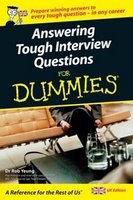
Just a quickie as I need to do some preparation before I coach someone in a bit. One of my publishers (Wiley) just told me that they need to do a new print run for one of my books, Answering Tough Interview Questions for Dummies. Apparently the first run has sold out and the book only came out in April!

Yeah for me!

Despite the fact the book is called 'for Dummies', I tried to pack it with really useful advice for job hunters - everyone from school leavers and graduates to women returning from maternity leave right through to senior managers and older candidates nearing retirement. Out of the 10 or so books I've had published to date, it's one of the ones I'm most proud of. The fact it's selling well must mean that readers are finding it useful too.

Anyway, I'm going to be smiling for the rest of today!

Monday, July 31, 2006

Networking: Making a great impact every time

As I mentioned in a previous post, networking matters.

And of course anyone you meet for the first time may ask what you do for a living.

One of the keys to effective networking is to think about your initial response. 'I'm an accountant.' 'I run an HR consultancy.' 'I'm an IT systems manager.' Yes, it might be technically correct to use your job title. But is that how you want to be remembered? Does your job title sum up all the aspects of what you do and capture your experience and tell other people how they can help you?

Probably not.

A friend and contact of mine, Julian Goldsmith, is managing director of PR agency ARC Business. He sometimes describes his work by saying: 'I undertake the writing of press releases, articles, speeches, and reports. I arrange journalist interviews, organize events, and place people in conference speaking slots.' But sometimes he merely says: 'I make business people famous'.

Which do you find more memorable? Which would make you want to hear more?

So the next time someone asks you: 'What do you do?' be sure to think twice about your answer 'cause it's one of the rules of networking.