Showing posts with label Office politics. Show all posts

Sunday, August 19, 2007

The voice of reason

My publisher Cyan/Marshall Cavendish asked me to record a podcast a few weeks ago, which has just been put onto itunes.

The podcast is a 20-minute discussion in which the interviewer asks me to provide various tips on the topics of office politics, job hunting, entrepreneurship, and networking. So if any of those topics interest you then you might like to download the podcast.

Now I'm not a terribly computer savvy person, but I believe you just tap in the words 'cyan marshall cavendish' into the search box of itunes and it should come up with the podcast's location. Even if you don't have itunes, you can download it for free. There's also a bunch of other podcasts by other authors in the Cyan/Marshall Cavendish stable too - so you can learn about other topics ranging from cold calling customers to giving great presentations.

I hope you get a chance to download my podcast - it'll be a chance for you to hear my thoughts rather than read about them for a change!


Monday, July 30, 2007

Office politics: Just do it

Office politics gets a bad rep. But I consider it one of my missions in life to convince people two things:

  1. That you will make it harder for yourself to thrive within your organisation without playing the political game.
  2. That politicking isn't necessarily 'bad'. You can be political and ethical too.
I was recently asked to contribute as part of a panel of experts to an article in a business magazine on the topic. Click here if you want to download the pdf file and read it (it's short and to the point!)

Wednesday, April 18, 2007

Office politics: The argument for getting political

Office politics has a bad reputation.

But here's the reality: politicking happens whether you like it or not. Yes, some people try to be noble and refuse to play the political game; they focus on their jobs and work hard in the hopes of being noticed and rewarded for their efforts. But sadly there are limited opportunities in the world of work and, more often than not, these sorts of people end up being overlooked or ignored – either by colleagues or important customers or both. Do you want to be overlooked or ignored?

Of course not.

Many purists refuse to play the political game, believing it to require underhand tactics and a malicious intent. But politics are not automatically bad. Politicking merely describes the act of scrutinising business relationships and learning how to influence others more effectively.

It usually involves going through informal channels rather than officially sanctioned ones, but that doesn't make it bad in and of itself.

Nor does politicking have to be selfish. You can use your understanding of politics to influence people and achieve goals that are good for the organisation as well as yourself. Even in the most friendly and supportive of organisations, people don't always agree – so having an understanding of politics and how to exert influence can help you to pull people together and achieve outcomes that are in the organisation's best interests too.

Anyway, if you want to read more on the topic, bits of this article are taken from a lengthier one that I wrote a few months ago for management-issues.com - happy reading!

Wednesday, November 08, 2006

Office politics: An homage to Niccolo Machiavelli

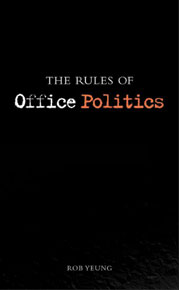
I just got a physical copy of my new book, The Rules of Office Politics. It's always an incredibly proud moment for me to hold in my hands an actual copy of the book with its hard back binding and wrap-around cover.

But today I thought I would pay homage to the father of office politics, Niccolo Machiavelli.

Machiavelli had been in a senior position of power in Florence, Italy when Spain invaded his country and he was captured, tortured, and banished. It was during his exile that he wrote his tome on politics, The Prince.

Things have moved on in the world of management since Machiavelli wrote: "it is better to be feared than loved if you cannot be both". Nowadays, in a world in which good quality employees are hard to recruit, most modern-day managers realise that it is better to manage with carrot than stick.

However, Machiavelli still has much to teach us. Particularly on the topic of change, he writes: "There is nothing more difficult to carry out... than to initiate a new order of things. For the reformer has enemies in all those who profit from the old order, and only lukewarm defenders in all those who would profit by the new order."

While Machiavelli's morals may be questioned (hence the term 'Machiavellian' being applied to all manner of dubious manouevrings), what he did teach us was that it is wise to take a strategic approach to building relationships and trying to get things done at work. And that's certainly a message that I have taken forward in my own tome on the topic of office politics.

Sunday, October 15, 2006

The Rules of Office Politics

Office politics is the game that is played in just about every organisation out there - but so rarely talked about.

To be 'political' is almost always seen as a bad thing. You might be thinking that office politics involves skulking and scheming, colluding and conniving. And it’s true that a lot of that goes on. But that doesn’t mean that all politicking at work is automatically bad. Understanding the rules of politics can help you achieve outcomes that are beneficial for the organisation and in an ethical fashion too.

But I think that unless you are not at least aware of politics within your organisation, you will not succeed. Being politically savvy is nothing more than recognising the politics within your organisation, reading people, and learning to build relationships with them.

Anyway, my next book is published next week. And in the run-up to its publication, I've managed to get some good press coverage for the book. The book had quite a lengthy write-up in the Sunday Times, so you can read all about it there.

You can read the full article

Friday, June 30, 2006

What can Paris Hilton and Jade Goody teach us about work!?

Would you believe that heiress Paris Hilton is launching her debut single in July? And surely you would have thought someone was joking when reality TV star Jade Goody launched her own fragrance onto the market?

But these are no jokes; no one is laughing - except perhaps Paris and Jade, all the way to the bank.

Even though you'd be hard pressed to say that they are good role models for anyone, they do at least illustrate an important point about how to achieve success at work: Being visible and having a Profile counts.

In the world of work, we all know people who are incredibly good at their jobs - but who haven't been promoted. Perhaps it's because they don't play the political game or because they would rather let their achievements speak for themselves rather than talking them up. And we all know people who aren't that good at their jobs, but they're good at talking about themselves, saying the right things, being visible - and unfortunately it seems to be this latter crowd that often gets the promotions, the sexy projects, the kudos and glory.

Arguably, you could say that Paris Hilton has no real talents other than the fact that she turns up to the opening of an envelope and is never knowingly over-dressed. And Jade Goody has no talents as a singer or dancer or actor or comic - she's known simply for being a self-publicist. But simply having a Profile has done both of these celebrities a world of good.

The same goes for the world of work too. It doesn't matter how good you are unless people know it. Being seen to be good at your job and having your contributions recognised by the right people - that's the important lesson in getting ahead. It's not fair; it's not right. But, hey, that's the way the organisational cookie crumbles.